Brazil is one of the largest and most fascinating countries in the world. It is the fifth-largest country in terms of land area, covering approximately 8.5 million square kilometers. This vast landmass places Brazil in the 5th position in global rankings, just behind Russia, Canada, China, and the United States. It’s also the largest country in South America, occupying nearly half of the continent. The country is famous for its vibrant culture, beautiful beaches, and rich natural resources.
To put Brazil’s size into perspective, it is almost double the size of the entire European continent. While the European Union spans about 4.5 million square kilometers, Brazil’s total area is over 8.5 million square kilometers, making it a giant on the world map.
Brazil is located in South America and shares borders with 10 countries: Argentina, Bolivia, Colombia, Guyana, Paraguay, Peru, Suriname, Uruguay, Venezuela, and French Guiana (which is an overseas region of France). This strategic position allows Brazil to play a vital role in the continent’s economy and international relations.
The capital of Brazil is Brasília, located in the Federal District. Unlike other cities, Brasília is not part of any state; it was specifically designed to be the capital of the country and is known for its modernist architecture and unique layout.
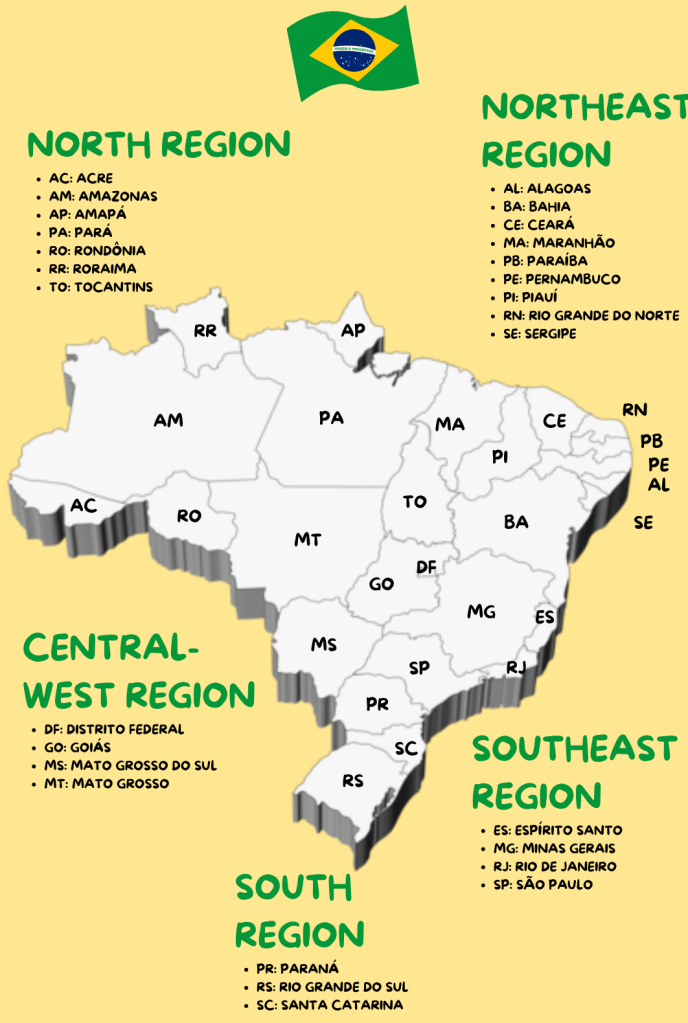
Brazil is divided into five regions: North, Northeast, Central-West, Southeast, and South. Each region has its own distinct cultural identity, climate, and geography. Within these regions, Brazil has 26 states and the Federal District, which collectively form the country’s political structure.
Regions and States of Brazil
Here’s a breakdown of Brazil’s regions, along with the states that belong to each, and a brief description of the region’s key characteristics:
North Region
- States: Acre (AC), Amazonas (AM), Amapá (AP), Pará (PA), Rondônia (RO), Roraima (RR), Tocantins (TO)
- Characteristics: This region is home to the Amazon Rainforest, the largest tropical forest in the world. The region has a hot and humid climate and is rich in biodiversity. It offers abundant opportunities for eco-tourism and wildlife exploration.
Northeast Region
- States: Alagoas (AL), Bahia (BA), Ceará (CE), Maranhão (MA), Paraíba (PB), Pernambuco (PE), Piauí (PI), Rio Grande do Norte (RN), Sergipe (SE)
- Characteristics: Known for its beautiful beaches, cultural festivals like Carnival, and the unique Northeastern cuisine (such as acarajé). The region is also famous for the historic city of Salvador, one of the oldest colonial cities in Brazil.
Central-West Region
- States: Distrito Federal (DF), Goiás (GO), Mato Grosso do Sul (MS), Mato Grosso (MT)
- Characteristics: Home to the Pantanal, the world’s largest tropical wetland, the Central-West is a hub for agriculture and cattle farming. Brasília, the capital of Brazil, is located in this region.
Southeast Region
- States: Espírito Santo (ES), Minas Gerais (MG), Rio de Janeiro (RJ), São Paulo (SP)
- Characteristics: The Southeast is Brazil’s economic powerhouse, with São Paulo being the largest city in Latin America. The region is also home to Rio de Janeiro, famous for its stunning beaches, Carnival, and the Christ the Redeemer statue.
South Region
- States: Paraná (PR), Rio Grande do Sul (RS), Santa Catarina (SC)
- Characteristics: Known for its temperate climate, European cultural influence, and German and Italian heritage, the South is also famous for the Iguaçu Falls, one of the largest waterfall systems in the world.
Exploring the States of Brazil
Now let’s take a closer look at the unique features of Brazil’s states, highlighting their most popular cities and why they are worth visiting:
Bahia (BA)
- Highlights: Bahia is known for its vibrant culture, music, and historical significance. It is the birthplace of Brazilian Carnival and samba and has a rich Afro-Brazilian heritage.
- Popular Cities: Salvador (the capital), Porto Seguro, Ilhéus.
- Why Visit?: Bahia offers incredible cultural experiences with samba shows, historical sites like the Pelourinho district, and beautiful beaches like Porto Seguro. Salvador, with its colonial architecture and lively music scene, is a must-visit destination for anyone looking to experience Brazilian culture in its purest form.
Amazonas (AM)
- Highlights: Amazonas is home to the world-renowned Amazon River and the Amazon Rainforest.
- Popular Cities: Manaus (the capital).
- Why Visit?: Amazonas is a paradise for those seeking river cruises, indigenous cultures, and a deep connection with nature.
São Paulo (SP)
- Highlights: São Paulo is the largest city in Brazil and one of the most influential economic centers in Latin America.
- Popular Cities: São Paulo (the city), Santos and the famous beaches of the northern coast of São Paulo, such as Cambury, Juquehy, and Ilhabela.
- Why Visit?: São Paulo offers a cosmopolitan experience with modern art, world-class museums, and a dynamic food scene. It’s the place to explore diverse cultures and cutting-edge architecture. And above all, it has stunning beaches about 2.5 hours from the city of São Paulo.
Rio de Janeiro (RJ)
- Highlights: Famous for its stunning beaches, Carnival, and the iconic Christ the Redeemer statue.
- Popular Cities: Rio de Janeiro (the city), Angra dos Reis and Paraty.
- Why Visit?: Rio offers an unbeatable combination of beautiful landscapes, exciting cultural events, and lively beaches like Copacabana and Ipanema.
Minas Gerais (MG)
- Highlights: Known for its colonial architecture, historic towns, and rich culinary heritage.
- Popular Cities: Belo Horizonte, Ouro Preto, Tiradentes.
- Why Visit?: Minas Gerais offers a glimpse into Brazil’s past, with well-preserved colonial towns and delicious cheese, cachaça, and mineral waters.
Pará (PA)
- Highlights: Pará is home to the mighty Amazon River and the vast Amazon Rainforest. The state has a strong indigenous culture and is known for its exotic wildlife and natural beauty.
- Popular Cities: Belém (the capital), Santarem, Marabá.
- Why Visit?: Pará is ideal for nature lovers and those seeking adventure in the jungle. You can visit the Ver-o-Peso Market in Belém, explore the Amazon River, and experience the region’s exotic fruits and traditional foods.
Brazil is a land of contrasts, offering something for every type of traveler. From the wild, untamed jungles of the Amazon to the urban excitement of São Paulo and Rio de Janeiro, Brazil is a destination that never ceases to amaze. Whether you’re seeking adventure, relaxation, or cultural immersion, this diverse and vast country has it all.
 Brazilian Breeze | Experience Brazil like a local